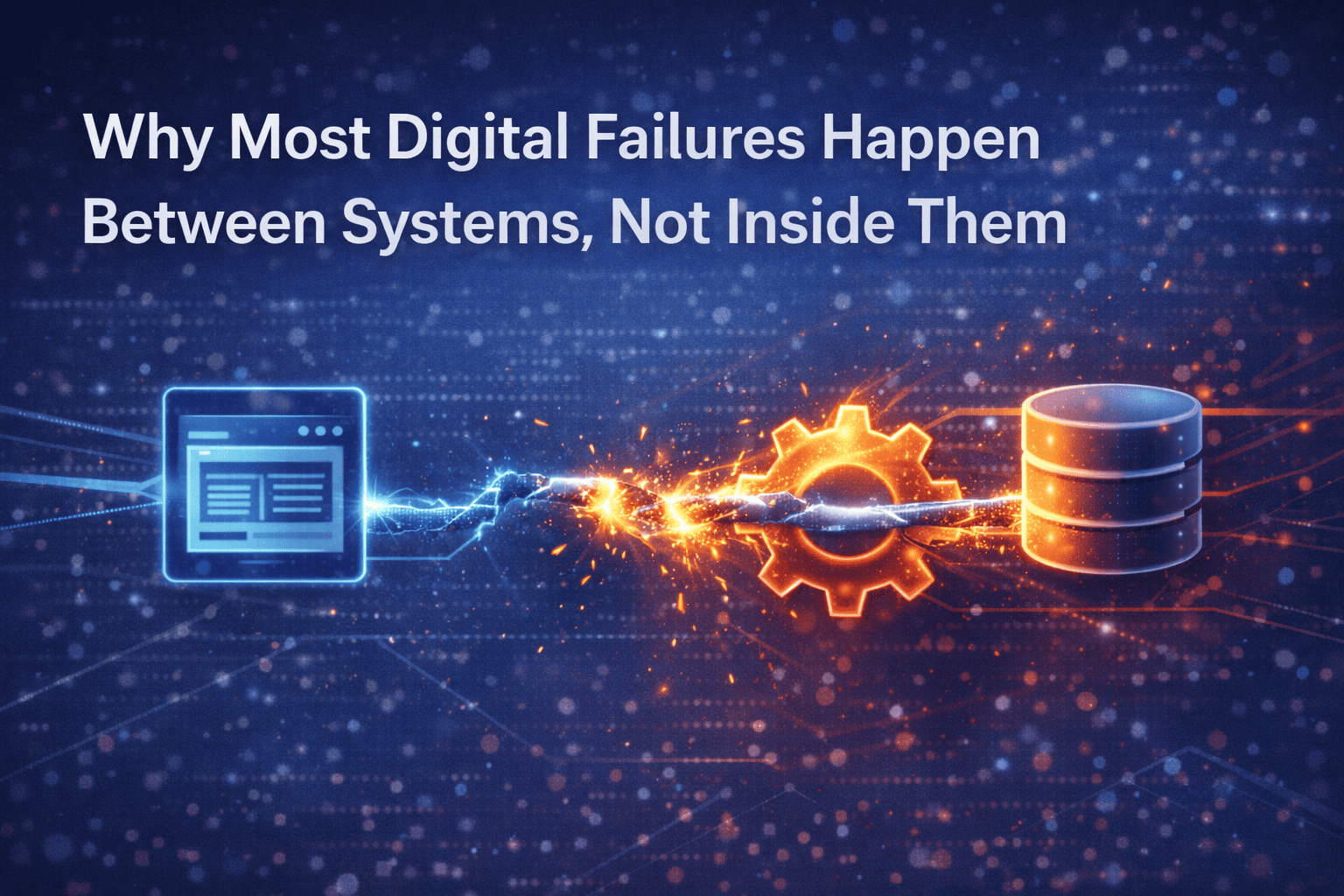
Most digital failures happen between systems, not inside them. Learn why broken connections, not broken tools, cause hidden performance and trust issues.
Why Most Digital Failures Happen Between Systems, Not Inside Them
When digital systems fail, organizations usually look inward. They audit individual tools, inspect codebases, redesign interfaces, or replace platforms. The assumption is simple: something inside the system must be broken.
In reality, most digital failures do not originate inside systems at all. They happen in the spaces between them.
The most damaging breakdowns occur not because a tool stopped working, but because systems stopped working together.
The Illusion of Isolated Systems
Modern businesses operate complex digital environments. Marketing platforms, analytics tools, CRMs, websites, payment gateways, support systems, and internal tools all coexist.
Each system may function perfectly in isolation. Dashboards look healthy. Features work as expected. Individual metrics appear stable.
Yet the overall experience fails.
This is because digital success is not determined by individual systems—it is determined by how well those systems connect.
Where Digital Breakdowns Actually Occur
Most failures emerge during transitions:
- From ad to landing page
- From email to product flow
- From QR code to mobile experience
- From support message to resolution
- From one platform to another
These handoffs are where intent, context, and trust are most fragile.
When transitions fail, users feel friction—even if no single system is technically broken.
Why Teams Diagnose the Wrong Problems
Failures between systems are difficult to diagnose because they don’t belong to any single team.
Marketing owns campaigns. Engineering owns platforms. Product owns features. Operations owns processes.
But the connections between these areas often have no clear owner.
As a result:
- Problems are misattributed
- Teams fix symptoms instead of causes
- Tools are replaced unnecessarily
- Complexity increases instead of decreasing
The Cost of Broken Transitions
Failures between systems rarely produce dramatic crashes. Instead, they create subtle but persistent damage.
Common consequences include:
- Lost conversions due to broken paths
- Inconsistent user journeys
- Data fragmentation and attribution loss
- Operational inefficiencies
- Erosion of user trust
Because these failures are quiet, they often persist far longer than internal system issues.
Static Connections in a Dynamic Environment
One of the biggest causes of inter-system failure is static connectivity.
Traditional digital connections—especially URLs—are fixed by default. Once created and shared, they cannot adapt.
But modern digital environments are constantly changing:
- Campaigns launch and expire
- Pages are redesigned
- Systems are migrated
- Products evolve
When systems change but connections do not, failure is inevitable.
Why “Everything Works” Is a Dangerous Assumption
Many teams assume that if individual systems are operational, the overall experience must be working.
This assumption ignores the reality that users experience journeys—not systems.
A perfectly functioning landing page is useless if the path leading to it is broken or misleading.
Fragmentation as the Default State
Digital fragmentation is not caused by incompetence. It is the natural outcome of growth.
As organizations scale, they add tools, platforms, and workflows. Each addition solves a local problem but increases global complexity.
Without intentional design at the connection layer, fragmentation becomes unavoidable.
Why Optimization Often Makes the Problem Worse
Ironically, optimization can amplify inter-system failure.
When teams optimize individual systems independently, they often introduce inconsistencies across the broader ecosystem.
Each local improvement creates global misalignment.
Performance improves in isolation while the overall experience degrades.
The Missing Layer: Connection Strategy
What most organizations lack is a deliberate strategy for managing connections between systems.
Connection strategy focuses on:
- How users move between platforms
- How context is preserved
- How change is absorbed safely
- How failures are contained
This layer is rarely documented, owned, or measured.
Why Links Are the Weakest Point
Links are the most common—and most fragile—connectors between systems.
They are shared widely, reused indefinitely, and often forgotten once published.
When links break, entire journeys collapse.
Yet link failures are often invisible until significant damage has already occurred.
Introducing Flexibility at the Connection Layer
To prevent failures between systems, organizations need flexibility where systems connect.
This means:
- Abstracting connections from destinations
- Centralizing control over pathways
- Allowing change without disruption
- Maintaining continuity over time
A smart connection layer absorbs change instead of transmitting it to users.
The Role of a Smart Link Layer
A smart link layer acts as a stabilizing intermediary between systems.
Platforms like Shrten.io provide this layer by decoupling public-facing links from internal destinations.
This enables organizations to evolve systems freely while keeping user journeys intact.
Why Ownership Matters More Than Tools
Even the best infrastructure fails without ownership.
Organizations that succeed assign responsibility for the connection layer.
They treat transitions as first-class assets—not side effects.
Failure Prevention Is Better Than Failure Recovery
Internal system failures are often obvious and quickly fixed.
Inter-system failures are subtle, persistent, and expensive.
Preventing them requires intentional design, not reactive troubleshooting.
The Long-Term Advantage of Connection Thinking
Businesses that invest in connection thinking:
- Scale more reliably
- Change faster with less risk
- Deliver consistent experiences
- Reduce hidden operational costs
This advantage compounds quietly over time.
How Shrten.io Fits Into the Bigger Picture
Shrten.io is designed to stabilize the space between systems.
By managing links as long-lived, flexible assets, it helps prevent the most common and costly digital failures.
It does not replace existing systems—it connects them intelligently.
Conclusion
Most digital failures are not caused by broken tools. They are caused by broken connections.
By shifting focus from systems to transitions, organizations can eliminate an entire class of failure.
In a connected world, success belongs not to the strongest systems, but to the strongest connections between them.